Metadata for Classical Releases
The standard that all metadata must adhere to is the Apple Music Style Guide:
https://help.apple.com/itc/musicstyleguide/#/
We use the Apple Music Style Guide (AMSG) as the baseline because it is by far the most comprehensive and rigorous published by the DSPs, and because most other DSP's requirements are fully compliant with it.
Within the AMSG, there is a section specifically for classical releases:
https://help.apple.com/itc/musicstyleguide/#/itc7a6525236
This guide serves as a summary of these requirements, but there are many situations in which they will not apply. Please read the AMSG thoroughly and, where unsure, contact us with any questions.
Album and Track Titles
Track Titles
All track titles for your release should take the general format:
Piece Title, Catalogue Number: Movement Number. Movement Title (Arr. for Ensemble by Arranger)
Where certain sections of this are not applicable, they can be omitted.
For example, movement three from Bach's Singet dem Herrn ein neues Lied in an arrangement for Brass Band by Debussy (if such a thing existed) would be formatted:
Singet dem Herrn ein neues Lied, BWV 225: III. Lobet den Herrn (Arr. for Brass Band by Claude Debussy)
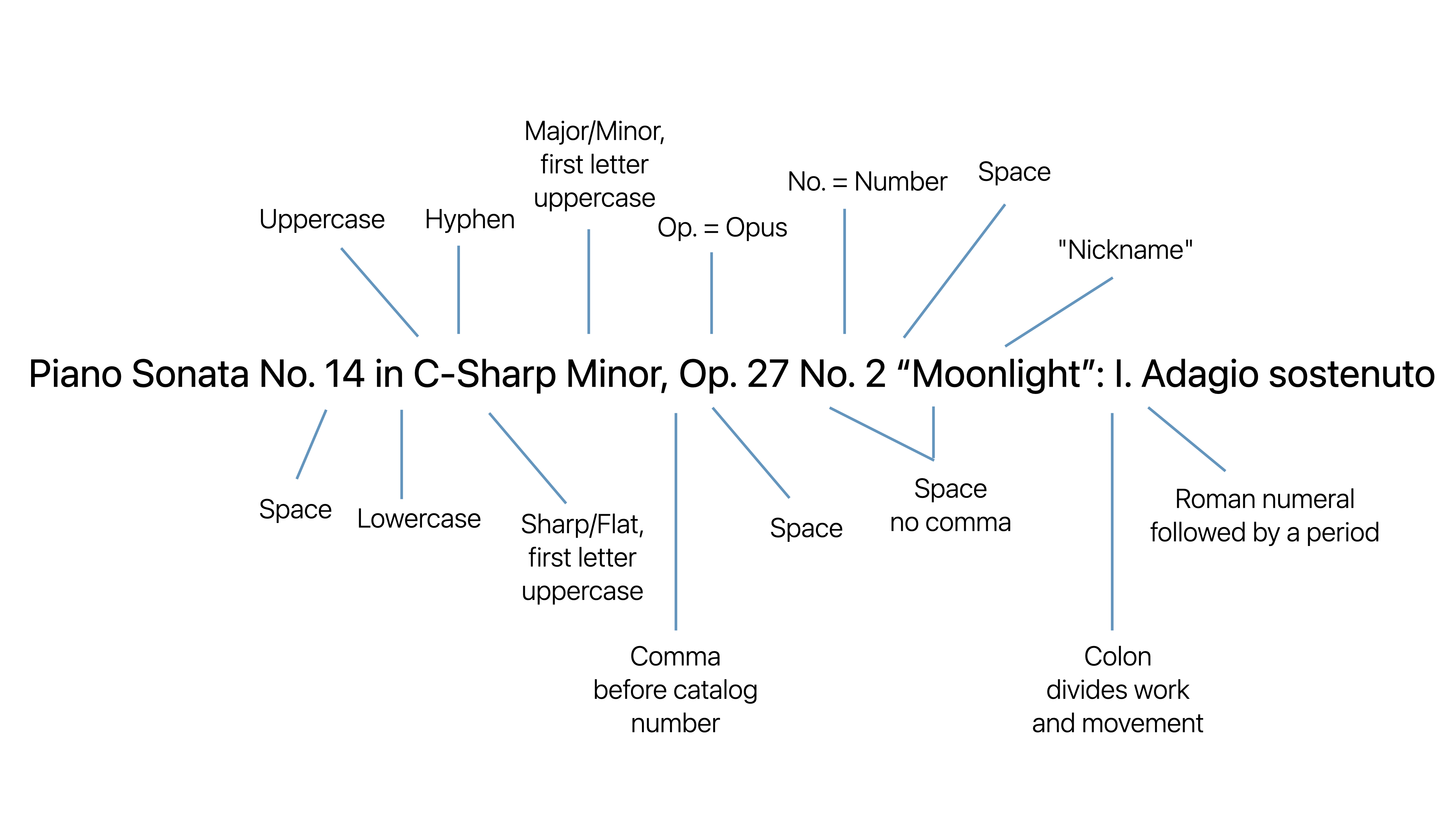
A series of excellent examples are provided in the AMSG, a couple of which are provided below:

Album Titles
- Where there is only one track on the release, the album track must be identical to the track title.
- Otherwise the following rules apply.
General format for albums of music by the same composer:
Composer: Work Title, Catalogue Number (Arr. for Ensemble by Arranger)
Let's break this down:
- If there is only one composer, start the title with the composer's name and a colon.
- If there is only one famous composer with that surname, it is acceptable to just use the surname.
- If there are multiple famous composers with that surname, use the first initial(s) followed by the surname (e.g. J. S. Bach).
- If there are multiple famous composers with same initials, use the composer's full name.
- Followed by the work title.
- Then the catalogue number, if there is one.
- If this is an arrangement, the ensemble and the arranger should be included after the title in parentheses.
Where the album comprises multiple works by the same composer, the convention is to separate them with hyphens. Where there are many different works by the same composer, it is preferable to choose a name for the collection (e.g. "Ligeti: Early Choral Music") rather than list every work.
Should the album be an assortment of music by different composers with a shared theme, an album title of your choosing can be used. If your album title is to include a subtitle, separate the album title and the subtitle with a colon - e.g. "At First Light: Music for Mattins".
Artists
The DSPs separate artists for the release into two sections: album level and track level.
The only kind of artist that you will commonly use for classical releases is Primary Artist; there are also Featured Artists and a few other special kinds, but it is recommended to not use those for classical, so they are not covered here.
There are rules around how many artists can be included at the album and track levels:
- At the album level, you are permitted to list only four artists.
- If more than four artists should appear the album level, it is necessary to use Various Artists. This is strongly discouraged as it prevents the release from appearing on your artists' profiles, therefore you should avoid this at all costs.
- At the track level, you may list as many artists as you wish.
- Where the release contains only one track, artists at the album and track levels must be identical - therefore, it is recommended to limit these to four also (for one track singles).
You should mark any performer that has made an individual and notable contribution to a track as an artist. For classical, this typically means conductors, soloists and accompanists. Individual members of an ensemble should not be tagged as an artist, as they are credited as part of the ensemble.
Artist names should ordinarily be their full given name, except where they are professionally known by an abbreviated name or sudonym.
Where an artist already exists on DSPs, you should use the same format (even if it violates the rule above) so that it appears on the same profile.
Unfortunately, the DSPs are not designed around classical music, so the constraints above can leave you in awkward situations where performers might need to be left off the list of artists, especially if you are releasing a one track single.
For example, if you are releasing a one track single with three soloists, a choir, a conductor and an accompanist, you have to choose between using Various Artists at the album level (which means that the release will not appear in your artists' discographies, but rather in the Appears On section which only exists on some DSPs) and not tagging some performers as artists. The latter is generally the correct decision, where the ensemble and conductor get priority, but this needs to be handled delicately and on a case-by-case basis.
Contributors
Alongside Artists, you will submit Contributors for each track. There are three kinds:
- Performer
- Writer
- Production & Engineering
It is required to submit at least one Contributor in each category.
The general recommendation is that Performer Contributors should match your Artists, though more extensive lists comprising every member of an ensemble, for example, can also be provided if desired. Along with the name of each Contributor, a Role must also be specified - for example, Orchestra, Conductor, Soprano Vocals, Organ. A complete list can be found here in the attached "iTunes Extended Contributor Roles" spreadsheet.
For Writers, you will need to assign at least a Composer. If the track is a performance of a vocal work, a Lyricist must also be provided. If the track is an arrangement, an Arranger must also be provided. Multiple of each can be specified.
For Production & Engineering, you must assign at least a Producer and a Recording Engineer. Other roles are available where more staff were involved - for example, Mixing Engineer, Mastering Engineer, etc.
Lyrics
If a track on your release is vocal - meaning that it is sung by a vocalist, a choir, a chorus, or another kind of vocal ensemble - it is required to provide lyrics for that track.
These lyrics are a verbatim transcription of what is heard in the track, not the formatted libretto that you might see at the front of a score.
The general rules are:
- Each line must begin with a capital letter
- With the exception of question marks and exclamation marks, you must not use punctuation marks at the end of a line (even if it concludes a clause)
- Where there are repetitions of a given word, these must be written out - for example, write "Alleluia, alleluia, alleluia, alleluia" rather than "Alleluia x4"
- Where there are repeated lines, these must be written out
- You should be transcribing the most important/audible text, so if there are multiple texts being sung simultaneously, transcribe the one that the listener is likely to follow
- Where there is a clear change in section, leave a line - this helps to identify the structure
- Non-linguistic sounds like Ah, Ooh, Oh, Ee, should be transcribed using the format that might appear in a vocal score
- Do not include anything other than audible lyrics in your transcription
- Any expletives must be transcribed - they may not be omitted
Examples can be provided on request.
Transcribing lyrics is somewhat an art form in itself, so it is expected that two transcriptions of the same track will have differently-presented lyrics but both will be compliant with the above requirements.